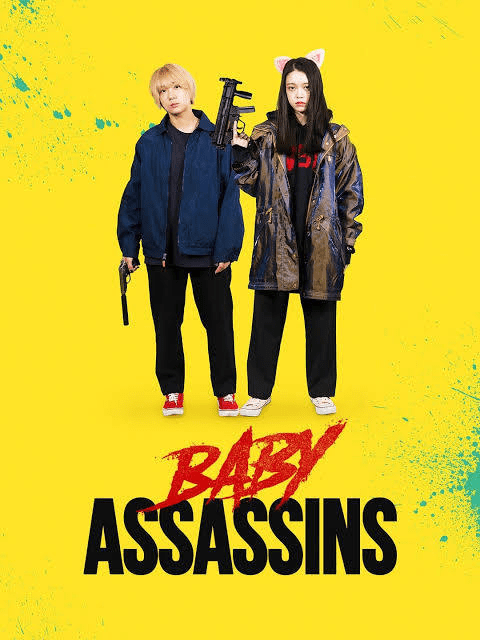
Hello!! I am emerging from a long cocoon of madness to beg you to watch three movies and a 12 episode tv show. They’re not in English, are scattered across several disparate streaming platforms, and are not popular enough to gain you any social cache from watching it. I know. I know dear friends and enemies but you see. I need Baby Assassins to catch on. At least among a certain kind of nerd. The problem is, the kind of people who will watch a gory action comedy and the kind of people who will watch foreign films rarely overlap. And so I must find other ways to sell you all on this.
The Shipper Angle: This is the easiest. I know who is mostly reading these: people who follow me on tumblr. Many of whom are lesbians, or at least reblog a lot of posts decrying a lack of f/f shipping. Have you ever thought “wow I wish this codependent duo of murderers were women” while scrolling through your dash? Oh boy do I have the series for you. Our titular Baby Assassins are Mahiro, an awkward, shy young tomboyish autistic woman and Chisato, her vivacious, enthusiastic, super femme bff and assassin partner.
At the start of the series, they are being transitioned from being child assassins to adult assassins, and are assigned to live together and find part time jobs. The emotional core of every installment is the relationship between these two girls. In the second one some boys are introduced that, for a while, you do assume are going to be love interests.
Extremely no! Baby Assassins is great because it always, always ends in Mahiro and Chisato reaffirming that they are the most important person to each other, no matter the challenges, be it crazy yakuza guys, horrific sales team jobs, or bullet wounds. They love each other. Like, canonically, as of ep 12 of the TV series. You want two women you can put in both domestic and high stakes genre situations? Good news! This series is already doing that! All you gotta do is jump in.
The Aromanticism Angle: If you are reading this and are not a lesbian, you are very likely someone who posts a lot about how we need more shows where there is no romance whatsoever and a platonic relationship is elevated above all else. Good news for you my friends and enemies! The relationship between Mahiro and Chisato is not Textually romantic. They are: best friends.
They are codependent best friends who have been contract killers since they were 14-15 (the timeline is Unclear across installments. It’s action movies. This happens.) They actively make fun of romance and people in relationships. They are each other’s most important person. They do say “I love you” at the end of the series, sure, but there is no reason you have to read that as romantic. There is enough textual support for a queerplatonic reading here. You could have some really nasty fandom wars with the shippers, even. I know that is attractive for some of you. (I kid, I kid.) Point is, this is what a lot you are looking for. You just don’t know its there.
The Disability Angle: Another genre of person reading this is someone who really, really cares about disability representation. Well let me tell you about Mahiro. Mahiro is an autistic woman who can’t hold down a job. Sure they say “communication disorder”, as far as I can tell this is polite Japanese euphemism for autistic. I am sure there’s social context I’m missing but I’ve run into that phrasing in enough things at this point, and googled around a little, that this is at least part of it.
And that’s important because Mahiro’s plotlines express a reality of disability I’ve never actually seen in fiction before. Mahiro cannot hold down a real job. She’s awkward. She’s clumsy. She’s bad at most things. She can really only talk to exactly one person. (This expands to around 3 1/2 people by the end of the tv series.) She’s not pretty enough and isn’t trying to be. She won’t make comprises about her appearance. She is really only good at one thing and that thing is killing people. And her angst is never about killing people: it’s about the being bad at real jobs.
And instead of her arc being her learning to push through this and Be Productive she: has to learn to accept herself for this, and find other avenues of success. She has to apply to learn to be a getaway driver (something the series kinda forgets about but I didn’t) when it becomes clear she can’t blend in with normal society, but this is presented as another avenue of success, not an inherent failure. Chisato (almost, she’s got her own stuff going on) always celebrates when she is honest and asks for help. Her path is presented as more perilous, less sure, and rockier than Chisato’s but that’s what being this kind of disabled is like in real life.
Also: Mahiro can’t get hired, but Chisato’s the one who is always killing her coworkers. She only can ever get so far before the indignities of working life catch up to her and she snaps and shoots everybody. Sometimes she’s able to refrain and only kills a bad customer. Which is both really, really funny and also something you can read as the experience of invisible disabilities vs visible disabilities. In the show Chisato, under intolerable amounts of stress at her new assassin sales team job, makes a mean comment about Mahiro “using her disorder to get out of work”, and it is made painfully clear that she doesn’t even think that. She just sees Mahiro’s experience of disability, in that moment, as preferable to her own. (The answer to this conflict by the way? Killing all of Chisato’s coworkers. Bc this is Baby Assassins, and it rules.)
The Critique of Capitalism angle: The last sort of person I am almost sure I can sell this series to is people who really, really need their entertainment to be selling some kind of value. Now, it is satirical in many ways, and I know that can often be difficult to glom onto, but all the critique is so pointed at the modern world and systems of work that I think even the most dyed in the wool discourser will be able to see value here.
Because this is an action-comedy, sure, but most of the comedy comes from realistic workplace foibles. The action in the second movie? Kicked off because the girls fucked up switching their assassin insurance plans when they turned 18. The emotional crux of the first one? The indignities of working at the worlds’ most thematically incoherent maid cafe. A major arc in the show? A nightmare ten day team building exercise that ends in an old man replacing everyone with an ai assassin drone in order to remain relevant in his old age, and his assistant fucking losing it.
But the critique of capitalism is best described through one joke in the second movie. Tasaka is a crime scene cleaner employed by the assassin guild. All Tasaka wants in the world is for 1: the girls to stop shooting people in the head, and 2: people to fill out their murder forms correctly. Small asks, that are never, ever fulfilled. In the second movie, Tasaka is training a woman who it is heavily implied will be his replacement one day. He gets shot, and then a solid few minutes are spent on Tasaka coaching his trainee on filling out the forms about what, in that moment, both we and Tasaka are sure will be his death. It’s such a brutal joke, a man’s final moments spent on greasing the wheels of bureaucracy that killed him. (He’s fine, bc the franchise knows Tasaka is too fun a character to kill off, and it makes All That way funnier, but still.)
Baby Assassins has a lot to say about Work, capitalism, and the systems in which people find themselves trapped. By taking place in a world that’s basically “what if John Wick but everyone’s an overworked dirtbag”, it knows it can present scenarios that are amplified echoes of real life problems. The assassin guild disability insurance scheme? Will send a guy to kill you if it finds your retirement is no longer cost effective. Team building exercises devolve into carnage because the old man who is leading it doesn’t get the lunch he wanted, and blames the young people who work for him. Chisato’s occasionally debilitating old gunshot wound? Revealed at one point to have been indirectly caused by the terrible working environment sales team she’s currently assigned to. Baby Assassins (besides the third movie where a lot of the comedy is dispensed of for more fight scenes, which like. Genre typical these things happen.) is a franchise that knows what it is skewering and why. Anyone who is working a really bad job right now should watch this despite their feelings on capitalism because I think it would be cathartic.
This isn’t the most analytic of my reviews but there’s a reason for that: I want to get this series to as wide an audience as I can. I want as many people possible to love it as much as I do. And by offering all the different readings of it, I hope I can attract as many people as possible. Because there’s a lot of love here. And I think this could get to cult classic status. If I can get people to watch it. So! Go watch Baby Assassins. And if you love it? Make your buddies watch it. Pyramid scheme it.
Signing off,
Marlowe

