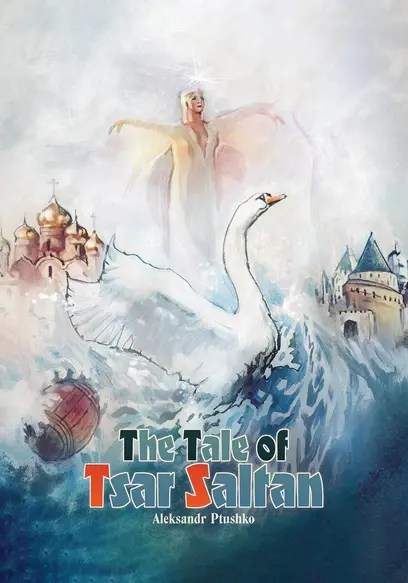
Dicking around on Kanopy is a great way to find weird bullshit. I watched one old Eastern European fantasy movie on the recommendation of a buddy of mine (The Mysterious Castle In The Carpathians, fun little movie you should go watch it) and fell down a rabbit hole where the only thing I think about is Tsar Saltan now, I guess.
I didn’t even know Tsar Saltan existed three days ago. I found it in Kanopy’s ‘related titles’ under Visitors From The Arkana Galaxy, another deeply weird Eastern European fantasy thing you should watch. Or that is, to say, I found the 1967 live action adaptation of it there.
Marlowe what are you talking about, you are asking. What the hell is Tsar Saltan? Tsar Saltan is, apparently, a poem by Alexander Pushkin, king of the Russian fairytale and cornerstone of Russian literature. You can read it here on the online database of Marxist children’s literature on their gloriously retro website. And why have you not heard of it?
Probably because it’s not very good. I read a lot of fairytales, especially fairytales in translation. Pushkin is doing a rhyming thing that, when you watch that adaptations, clearly is doing something really cool in Russian that is maybe not possible in English. So we are missing something in the language inherently. But honestly the reason it’s not very good is just one of those inherent problems in old fairytales. It goes on for fucking ever. Prince Guidon, our hero, acquires a collection of Wonders to attract his long-lost father to his magic kingdom and boy does it go on a While. This is a thing that’s great in like, an oral tradition that is less interesting when read, and even less interesting when you try to make a movie about it.
This is where the 1984 cartoon adaptation (that you can watch here because the original dream of the internet is alive and well in far flung corners of youtube) fails, I think. It has all the energy of something your teacher put on because she has a hangover. There’s some cool moments, sure, like some really cool animation when the Tsar’s advisors go up a spiral staircase with lit candles and their shadows play on the wall, and I liked keeping the bit that the live-action movie cuts out where Prince Guidon, turned into an insect, blinds his evil aunts by stinging them in the eye.
But the problem with faithfully adapting old fairytales is a lot of times they’re really boring. The 1967 live-action adaptation (that you can watch here on Tubi because Tubi has the fun cool stuff that other streaming services refuse to touch in favor of mass market mush) understands this. It understands that the bulk of the poem is the least interesting part, and invents some cool flourishes to make it interesting, like the city full of frozen people the Guidon and and his mother have to wake up, and the increasing control that the courtiers have over the Tsar.
It also makes sure the accumulation of wonders isn’t the Whole Story by adding some plot details and dialogue not in the poem. But still in rhyme! Which really is an impressive feat, even if the english translations really torture some of the rhymes. And boy do they. The red headed evil advisor who joins up with the evil women to scheme against the Tsar? Not in the poem! The bit where the Tsar and his wife play patty cake in their marriage bed? Not in the poem! The bit where the poor persecuted queen puts out a fire during her presumed execution? Not in the poem! And yet it’s these things that really make the movie.
These things, and the design. Because my god you have never seen anything more lush than this. There is a calculated artificiality to it. This is not a faithful recreation of the past, nor does it want to be. We are in fairytale land and every design choice is reminding us of this. The evil weaver sister’s painted on freckles. The beautiful painted backgrounds. The guy who, as the king throws a tantrum, is just jamming away on a giant pyramid made of bells. The woman who is also a swan and you know when she’s a swan and not a woman by the length of her sleeves. There is almost an element of ballet to it, especially when the swan woman is around, and in the staging of certain shots.
So what do we learn from this? What is the point of writing this? What is the point of watching old movies that no one else is watching instead of conforming to the tastes of our peers like a productive member of society? Well first off it’s fun as hell. Second, it helps crystalize a long held belief of mine: sometimes a faithful adaptation is Worse. Sometimes you have to cut some boring bits, and add some more fun ones, to make the work you’re adapting really shine. Realism, also, is overrated. A realistic fairytale adaptation is pointless. You want to walk into a dreamland for a little while, sometimes. That’s what a fairytale is For.
The ’67 Tsar Saltan reminds us of these things. It encourages us to be inventive, to play in the space the genre is giving us instead of desperately pretending it’s not what it is. And it has a hell of a lot of fun while doing it. In doing so it somehow manages to be more cartoonish (complimentary) than the actual cartoon adaptation, which is no small feat.
‘But Marlowe’ you are asking ‘is it still worth watching if I do not care about these writerly concerns?’ Yes! It’s fun as hell! I love a good fairytale movie and this has rocketed into my top ten. If you love this sort of thing, you’ll love this. Go watch it! Have some fun! And report back if you do.
Signing off,
Marlowe

