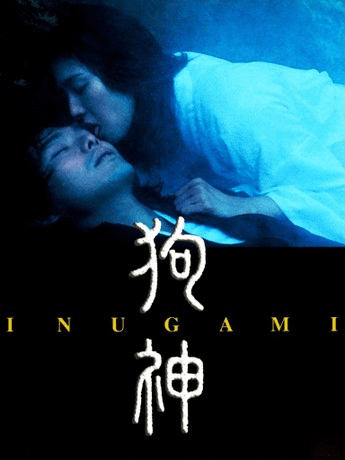
Shudder is the last streaming service that I use that still has user reviews for every movie on its service. It makes sense for most services not to have this, it takes up server space and attracts cranks, but it also makes sense for Shudder specifically. How often as horror fans do we find a new favorite movie because someone was a little too loud about how gross they thought something was? At least a couple times a year. Shudder seems to understand this, and in this way I came across Inugami, and became immediately intrigued by all the reviews complaining about the incest.
The downside to including these reviews is, of course, that even the people who liked it are misrepresenting it. Inugami is not the mindless shock value b-movie the reviews made it out to be. It is a much rarer gem than that. I understood it to be a very clever movie about how familial and community forces conspire to perpetuate misogyny and sexual violence. And not at all subtle in its themes, either.
I’ll start this off by saying I’m well aware I’m missing a lot of social context here, and admit that any reading of this movie by someone who is not well versed in both Japanese folklore and 2000s Japanese politics is going to be a little incomplete. That said, I do think the thematics are so unsubtle that this background knowledge would likely bolster my reading. That said: I could be Wrong, and I fully admit that.
Inugami is a film that is often confusing on purpose, there are dream sequences that feel very real, hallucinations that flit in and out, mysteries of parentage, small town secrets, and inconsistent cult bylaws. What you really need to understand is four things:
1: Onime: a village so remote that modernity has caught up to it only in fits and starts. Where the ‘resident rocker chick’ delivers packages, old timers hang out at a bus stop that’s been defunct for 10 years, and superstition, rumor, and secrets haunt every corner.
2: The Bonomiya family: A strange, isolated family cult that owns a lot of the forest around the village, has only recently allowed electricity in their households, and is the center of a lot of fear and superstition among the people of Onime.
3: Miki: an unmarried woman of the Bonomiya family, treated badly by the family and townspeople alike, and really only held in any esteem by her sister and a young man who suspects she may be his birth mother. The last traditional papermaker in a family and region once known for it.
4: Akira. The obligatory outsider in this kind of movie, who comes in, sees Miki’s treatment by everyone, and promptly falls in love with her.
This is not that unusual set up for this kind of movie. We have seen this before! Small town, dark secret, woman caught up with it, handsome man is here to help. We know this. We have been here before. Not to Onime, but to towns like it. We are expecting ghosts, we are expecting demons, we are expecting curses.
What we are not expecting is: when everyone in the household experiences Portentous Nightmares, 2/3 of the ones we actually hear about are explicitly about childbirth, medical mistreatment of women, and the domination of the men over the women of the family. We are not expecting the plucky young paper factory owner who is mildly obsessed with Miki to be warned off her because ‘the blood of dogs runs through her veins’, which is explained at the time to be in relation to the Bonomiya family curse. A curse that only effects the women. We do not expect Takanao, the head of the family, to explicitly make rules that allow technology only for him and his children, but not for the benefit of the women of the family. We do not expect barbs at the dinner table from a sister in law about how the men of the family only see the women as wombs.
And because we do not expect these things, even as they add up, when the Reveal of Miki’s secret shame, when the woman who’s trying to clear-cut her beloved forest in order to both drive the family away and help clear Takanao’s gambling debts makes it very, very clear that the ‘curse’ is directly related to the incest: “A dog lies with its kin.” Lady Doi hisses at her grandson, Miki standing close, but never speaking in her own defense. “She had a baby with her brother. The blood of dogs flows through her veins.”
And at the point you do have to ask yourself: is there a curse. Are there really evil Inugami gods in that family urn? Or is there a family legacy of sexual violence, of cruelty, of inbreeding, of medical neglect, of exploitation? We have to remember Momoyo’s dream, about being cut open underneath the men of the family, as they decide where in her innards to put a new parking lot. We remember Takanao’s wife grinding on him in apology after a fight as he stares Miki down. We even remember Rika, Miki’s sweet sister’s, causal, almost pushy, nudity around her. When is a curse a curse? And when is it an excuse?
A thing you must keep asking yourself as the plot progresses. We know, at this point, that Takanao blames everything on Miki. His gambling debts, his crumbling relationship, his adultry. They are Miki’s fault. Why not the weird happenings around town? Why not the strange murder suicide by a stranger from Tokyo who drove up here and offed his family and himself? Why not the pregnancy? Why not his attempted rape? Why not the seizure the messenger girl has? Why not Lady Doi’s heart attack? Did Miki truly release an Inugami to wreak vengence, or do things just Happen, and Miki is the easy one to blame?
Because we cannot trust the Bonomiya men. We know this. The women of the family tell us as much, in those words, over, and over, and over. When we learn that whenever a Bonomiya woman leaves the valley, the men bring her back, is that truly supernatural happenings, or is that folklore as a means of control? When the townspeople smash Miki’s papermaking workshop, do they truly believe she is causing deaths, or is a good way to remove an obstacle between them and building their golf course? Is Miki truly possessed by her mother, or has the strain of living under these conditions just finally cracked her open? And even the mother-son incest so decried in the reviews: is Akria truly Miki’s secretly baby swapped son, or is this 11th hour twist an Excuse to burn her alive at the Ancestor Rites ceremony, to rid the men of their Problem, and to give the town their golf course? We only have the nurse’s word for it. The townspeople and Bonomiya men both readily believe it but we know we can’t trust either of them when it comes to fair treatment of the Bonomiya women.
It’s that Doubt that really makes this movie. The fact that most of the supernatural happenings are observed through Miki’s pov. Are these real or is she unraveling under the strain? Is she cursed or is the curse a social atmosphere that allows for sexual violence and no recourse for the violated? The cops call it a family matter, and then a village matter, and then a matter of the gods. Anyone who tries to help is too small in the face of the collective. And when suddenly we shift to black and white, and the townspeople have cordoned off the mountain path until morning, ‘when they can burn the bodies’, we realize it doesn’t matter. The family cult is self destructing and the people of Onime are going to help it along. Because even if the curse is real, even if Miki is truly regaining her youth with evil dog magic, even if she is causing frightening happenings around the town and it’s not just symptoms of the same encroaching modernity that has them razing their cedar forest for a golf course, the fact remains: the family and the community conspire to harm those women, and they have been doing so for a very long time.
I have never seen a movie that so clearly articulates how incestuous abuse happens, and how cultures of silence place victims in desperate situations, and how both familial and community violence intersects, feeds off, and bolsters each other, and the deep roots all of these things have in misogyny. This is a thing I write and think about a lot because of my own history, but I am used to encountering it in art only obliquely. Rarely are artists willing to look at the subject matter head-on and really tackle it. Director Masato Harado did, with Inugami, a movie that is so underseen there is no wikipedia page and little detail on its IMDb. Which is a shame. Because it’s a beautiful film, treats its subject matter with real care, and even while doing so succeeds at being a hell of a good example of gothic horror.
Watch this one. Maybe a couple times. Really chew on it. Roll it around in your brain. And maybe next time you see a review decrying a movie for having too much incest in it, maybe ask yourself: are the reviewers engaging in the same behavior the movie itself is decrying? Because sometimes. Sometimes they are.
Signing off,
Marlowe
 Marlowe Writes