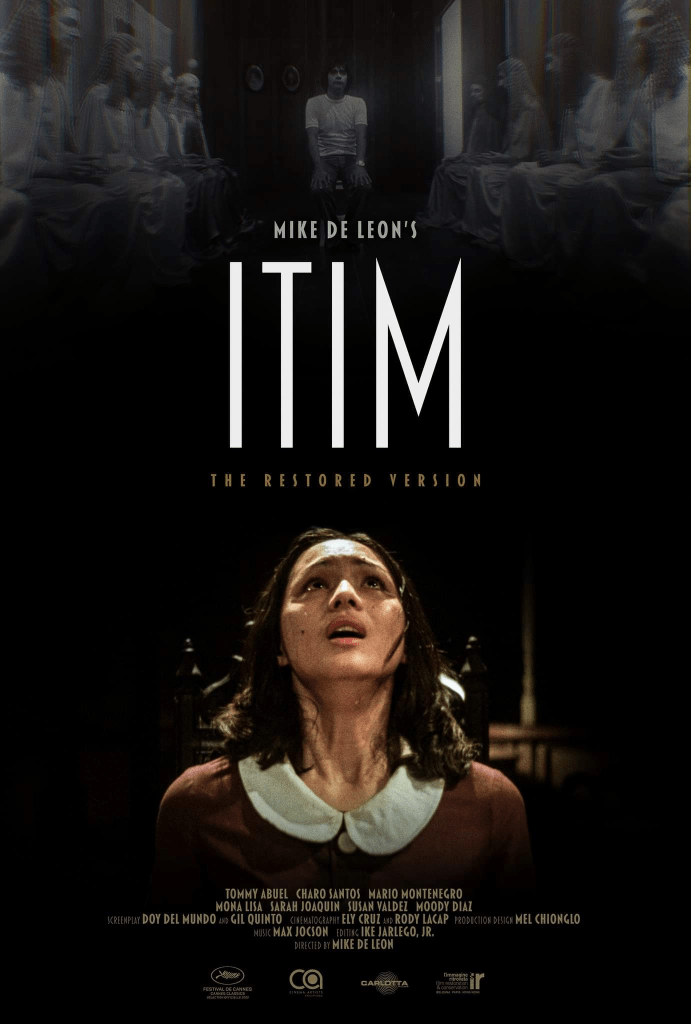
It’s wild that I have never heard of this movie. When you’re a genre guy, especially a horror guy, you Hear about more foreign films than your average jabroni because we are always on the look out for more Stuff We Like that is also good. A Marvel fan will always have their steady stream of recognizable characters and actors but if you want a really good ghost story you haven’t seen, sometimes you gotta go further afield. This is how people get really into J-horror or Korean zombie movies, etc etc. Most dedicated horror fans know at least a couple classics for a given country, even if they’ve never seen them.
So the fact that I’d never heard of this before randomly encountering it on Shudder is wild. By any right this should be a classic, and to be fair, it seems like in the Philippines, it is. For whatever reason it has not crossed over into American horror fans’ orbit yet. Which is a damn shame because I think this is an all timer. I don’t say that often. I would rank this with The Others and I Am The Pretty Thing That Lives In The House as an all time favorite of the genre, and I am really hard to please with ghost stories, since they’re my favorite.
But man this is good. We have young Teresa and her mother Pining in one plot thread, kicking things off by searching for Teresa’s missing sister Rosa. They went to visit her at her convent years ago and no one could find a trace of her. The seance is undramatic, matter-of-fact, and extremely Catholic, lending the whole thing an air of religious legitimacy. My ex used to say Catholic countries were better at ghost stories because the filmmakers have a better understanding of Ritual than your average protestant American and while I am sure all countries have bad movies, this is one of them that really proves her point. The seance ends with the medium’s grim pronouncement: Rosa will have a message for them on Good Friday.
Meanwhile, the other plot thread concerns Jun, a hot shot photographer who’s come home from Manila, ostensibly to visit his catatonic father for the holiday but actually so he can photograph the Holy Week rituals that the whole town partakes in this time of year.
And god, the house Jun comes home to might be one of the best haunted houses I have ever seen. Huge, built for many, many people and housing only four, and usually only three. Jun, his catatonic father, the elderly housekeeper, and her husband who we see but never hear. Once grand, now fallen into disrepair now that Bebang, said housekeeper, is more focused on looking after Dr. Torres than the house.
And always dark. Jun tries in vain to bring light into it. He opens the windows. The housekeeper closes them. He turns on lights and the bulbs sputter out. He carries a lantern with him to investigate strange noises and it barely cuts against the gloom of the big, cavernous house. He’s only one person, and is no match for the enormity of secrets his childhood home holds.
Contrasted against Teresa and Pining’s house, which is simpler, plainer, and made of the same dark wood as the Torres house, but is bright, open, and full of light. Where the lacy white curtains in Jun’s bedroom, which was once his mothers, only add to the sense of claustrophobia, in Teresa’s house the simple crotched white furnishings brighten the whole place. All she wants, after all, is to find her sister, and to understand these weird trance states she keeps falling into.
Because this is a gothic. And the best gothics are very often about themes of women railing against unjust social structures. And de Leon, our director, clues us in on this pretty early. Jun rolls into town listening to a news report about a woman trying to to seek justice after being beaten by a man. It is just this little background detail, but it’s also the key to opening up the entire mystery.
Bebang the housekeeper, too, lets us know pretty early on what the deal is. When the mysterious force that keeps trying to lure Jun’s father to his death by sending his wheelchair down the stairs tries it when Jun’s there, she tells him “This is god’s punishment for toying with all those women.” Jun doesn’t pay her any heed, then.
But as the movie unfolds, both Jun and the audience slowly come to realize that Bebang was right on the money, as folksy housekeepers often are, in this kind of story. Because Rosa does come back on Good Friday, riding Teresa’s body, in one of the most deeply uncomfortable seance scenes I have ever seen. The whole thing is largely a close-up of actress Charo Santos-Concio’s, who unlike many really good actresses in niche horror movies, I am happy to report went on to become mega famous in her home country, face, with a voiceover from the Ghost. And my god does Santos-Concio sell it. We can’t even hear her, on account of the ghost voiceover, but the physical strain of the possession and the emotional realization of the harm done to her sister are written so plainly on her face that that, coupled with the Revelations, is deeply uncomfortable in a really delicious way.
There is one more thing I want to note about the feminism of it all: de Leon does a very interesting thing that I really only noticed after the fact: there are only two men who speak in the whole movie: Jun, and the mysterious man he meets when photographing a prayer ritual at the church. Dr. Torres is catatonic, and Bebang’s husband is seen and not heard. A haunted house movie is really a woman’s domain, usually it is a woman who is haunted, and even in the few cases it’s not, it’s still a woman doing a haunting. You get a real sense that Jun has been drawn into this domestic world from his professional life, where suddenly different rules that he, as a man, is not as equipped to understand as the women around him are.
There are, of course, other things going on here. As with any horror movie about photography, and oh boy is this about photography, this movie raises a lot of fun questions about voyeurism vs observation vs participation. As with any horror movie about a small town boy who made it good in the big city only to come home in order to document said small town for his own gain, it raises a lot of fun questions about insiders vs outsiders. There is also just so much religious stuff, including a simply incredible dream sequence where Jun is attacked by living religious statuary, that I am simply not Catholic enough to understand but was delighted by all the same. As always I am sure there is political subtext I didn’t catch on account of I wasn’t in the Philippines in the 70s, but also as always, I really do think the movie is parsable without it. Gothic ghost stories are fairly universal.
All in all, you gotta watch this one. It’s a perfect example of its form, it has a stellar performance from its lead actress, and I really think it deserves to be seen more widely. It’s stylish, slowburn, and built on this slowly creeping dread that eventually swallows you whole. It’s also a really beautiful family tragedy about the lengths a woman will go to to help her sister, even if they didn’t like each other very much. You don’t want to miss this one, I promise.
Signing off,
Marlowe
 Marlowe Writes