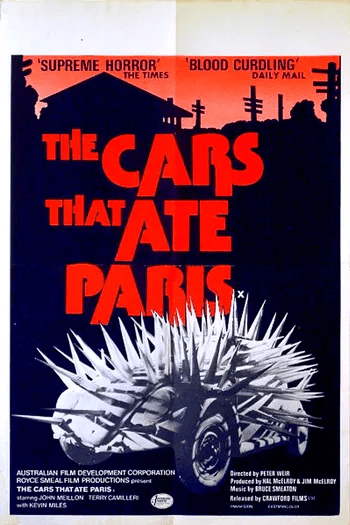
I was always gonna like The Cars That Ate Paris. It’s a movie that’s very catered to my general tastes and sensibilities. I knew that the minute I saw it on Criterion sitting in the horror section that you do have to wonder if it exists because horror fans are more willing to branch out to weird art movies than your average rando, but I digress.
The Cars That Ate Paris is a movie about violence, about permissible collective violences vs transgressive personal violences, about the violence of the status quo, about the violence the younger generation learns from the older generation. It is a movie about rural small towns, the oppressive atmosphere of living somewhere people are always watching you, about the tension between future and past, outsiders and residents, the desperate struggle to stay afloat in a world that’s forgotten you. It is also a movie about evil medical experiments and cars with big ol spikes welded onto them. In short, my favorite kind of thing. We threw art and pulp into a blender and got something great out of it.
The plot is fairly simple on its surface: The small Australian backwater of Paris has responded to the economic downturn of the 70s with an ingenious strategy: causing car accidents, stealing their stuff, and selling the survivors to an insane doctor to lobotomize and use in his evil medical experiments. These lobotomized patients are referred to as ‘veggies’, and some of them roam the town aimlessly, not part of the old guard citizens who are causing the crashes or the young rebels who cause chaos in their modified cars. They are In Paris but not Of Paris. They can’t leave, as the evil mayor loves saying, ‘No one leaves Paris’, but they ave become effectively un-personed by the violence committed against them.
The movie understands this. This movie understands a lot of things I don’t know if I’ve necessarily seen articulated on film quite this well before. I find Australian filmmakers understand the oppressive nature of the rural small town on a level a lot of others don’t. There is a scene that’s already a gem, but then it comes back later on after you’ve almost forgotten it to give you a hell of a punch, that I think is a perfect microcosm of the film’s statement on violence:
The men of the town sit around listening to a radio. The prime minster gives a pat speech about austerity, ending in a quote that implies that the people are responsible for solving the financial crises on . The radio moves on to tell us that 80 people have died in car crashes on country roads so far this weekend. The men get the signal. They go cause a car crash.
A little while after we get a beautifully intentionally tonally dissonant montage where we see the townspeople going about their day, and realize how deeply embedded into the fabric of the town’s economy these car crashes are: everybody either directly or indirectly, is benefitting from them. The grocery store lets you trade tires from crashed vehicles in for food or fuel. And played over this horrific revelation is the jauntiest easy listening music you have ever heard, creating an effect that is almost comic.
And we will come back to this scene, but we have to talk about Arthur and the mayor for a little bit. Arthur Waldo is our protagonist, sort of. He is a troubled young man who’s not able to drive because he once killed an old man in an accident. He’s terrified of cars. His brain’s a little fucked up from the crash that killed his brother, who raised him but ‘didn’t like him.’ The evil mayor, who, tellingly, despite being a character we follow as much if not more than we follow poor Arthur, is never referred to or credited as anything but Mayor, takes one look at the guy and says ‘we’re keeping him.’
So the whole town, including the evil doctor, who is likewise just credited Doctor, as if your position of authority than erases any identity you may have outside that, decides to gaslight this guy. This 25 year old at Least man. Who the mayor has decided to adopt as his son. He has done this before. He has two daughters. His wife cannot have children. “Orphans.” She tells poor, confused Arthur. “An accident.”
But those kids are like, ten. Arthur is a fully grown man. “I want you to join my family” the Mayor tells Arthur, after he tried to tell the only outsider who is allowed to come and go, the deeply inattentive village priest, that something is Wrong Here and gets immediately brushed off, “And one thing close family doesn’t do is talk to outsiders.”
Because The Cars That Ate Paris understands small town violence. It isn’t how the conservative pundits like to imagine. It starts as a culture of silence around The Unthinkable in the home. To neutralize the outside threat Arthur poses, the Mayor must bring him into the fold of family, to make him One Of Us, and initiate him into the hierarchy of those who do violence and those who violence is done upon.
Because there is a clear split in town, between the Mayor and the rest of the adults of the town, whose violence is covert, done with strict rules, and almost always under the cover of night, the young men, including one who tries very hard to befriend Arthur, whose violence is committed at all hours, but until the end of the movie, is largely relegated to loud noise and property damage.
The mayor complains the youth do not work. There are no jobs in town that are not related to killing people in car accidents. The mayor wants to modernize the town by removing veranda posts on the hotel and building a museum. The only reason anyone comes to the town at all is because they are lured by signs set up to bring people in to kill them with car accidents.
The mayor’s push for modernity is played in direct contrast to his clinging to the past. He gives Arthur a bullshit, made up parking attendant job, complete with khaki uniform and armband that evokes fascist uniforms, the day after he ‘adopts’ him because the car teens smash his racist statue. He gives a speech about how parking represents order that must be restored, and has a couple Good Men Of The Town hold these kids down in the dirt as he sets their car on fire. He throws a pioneer themed ball where people dress up as colonial figures and racist caricatures to celebrate modernity.
And he can do these things, because the mayor understands that when the Right People Do It, it isn’t violence. The youth, having grown up in this culture of covert violence, begin acting out with overt violence, and must be beaten bloody to be brought back in line. Violence is only violence when it’s out in the open, done by the wrong people.
And Peter Weir, our director, brings this home by driving one more nail into the coffin of the Mayor’s control over Paris: a veggie kills the priest. This lobotomized guy has been wandering around in the background with a hunting rifle this whole time. By the time he kills the priest you probably had already forgotten about him. But when the ambulance and tow truck bring this one in, and they uncover it to find the priest’s head blown off, the Good Men Of Town recoil in horror instead of getting to work. The shooter doesn’t understand. “This one’s mine.” He says. “You always take the good ones for yourselves, but this one’s mine.”
The Mayor orders him back to the hospital but that’s the true heart of the power dynamics that underpin the movie are laid bare by the shooter’s words: the violence that has made him capable of doing has also socially barred him from participating. In Paris, only violence can bring social mobility, but only the people on top are allowed to partake.
This comes to a head during that aforementioned pioneer ball in celebration of modernity. And this is where that speech comes back. The Mayor stands before the gathered townspeople as he repeats his refrain that he had his cronies rehearse about the priest being killed in a ‘tragic shooting accident’ and then rips off the prime minister’s austerity speech word for word. This petty tyrant doesn’t have an original bone in his body. He is pathetic, really, throwing tantrums about kids smashing his racist statue and dressing a grown man in a sailor suit because it amuses him.
And the movie understands this, too. Because of course the kids, who at this point, are being referred to be the Good Men Of Paris as ‘the cars’ crash the pioneer ball. Like literally crash it. They just start plowing into every building in town with their spike-covered cars. The mayor is mostly powerless to stop this. All the Good Men Of Paris are. One of them stands in the road in front of a spiked car and fully gets impaled.
And Arthur, as the newly appointed mayor’s son, has to make a choice. He’s trapped in a garage, in a car that he’s terrified of. The leader of the car punks, a guy who tried very hard to sincerely befriend him, is trapped behind him. The mayor is next to him, screaming at him to back into the guy. And he does. The mayor orders, and Arthur does as he commands. The guy’s screams turn from an almost friendly taunting to harrowing, and the mayor does not let Arthur stop. Again, he says, again, until his nemesis is a bloody pulp and Arthur stumbles out of the car sweaty and disoriented. The Mayor pats him on the head like the child he desperately wants him to be and Arthur marvels ‘I can drive!’
And he does. He hopes in the mayor’s sleek white car and books it out of there, with most of the citizenry of Paris. The youth tore down those outdated hotel verandas the mayor was so up in arms about, and in a way erase the whole bloody history of the town. The people flee on cars, on foot, in hand-drawn cars, as the mayor screams, impotent, powerless “No one can drive! No one leaves Paris! There are no safe roads! There is no way out! No one may come in or out! No one leaves Paris!” As everyone ignores him, leaving Paris. Arthur included, near delirious, behind the wheel of a car for the first time in the movie, baptized in blood.
And there’s a lot more going on in this movie that just this. I haven’t even talked about the mayor’s implication that this happens everywhere all of the time, or the weirdness with his wife, or the tension of religion vs violence, but this has gotten long enough as is. For that you’re going to have to watch the movie.
All in all The Cars That Ate Paris leaves you with a question: are the titular ‘cars’ that ruin the town the teenage punks, or are they the cars that are crashed and scrapped in order to keep the community functional and alive? I know what I think the answer is, but I highly recommend you to check this one out for yourself, come to your own conclusion, and report back. It’s a hell of a ride for a 90 minute movie. I really loved it. I hope you do too.
Signing off,
Marlowe
 Marlowe Writes